Editor settings
The Editor Settings are global for the Next-Gen Editor and will apply to all the topics and publications you work with. However, the settings will only be applied to your user account. Other Paligo users can set up their own preferences.
Control which elements gets automatic IDs from Paligo, see Global. Change the color scheme for the source code editor, see Source code editor. Select math editor, see Editing. Enable or disable automatic validation against the three different sets of validation rules, see General.
Under the General tab you will find settings for both Paligo as well as Schematron validation.
Paligo can check that your content is valid either manually or before the topic is saved to the database. But these checks will only take place if one or more of the validation features are turned on for your topics.
To turn validation on or off and choose which rules are used:
Select the Editor settings button
 .
.Paligo displays the Editor Settings dialog.
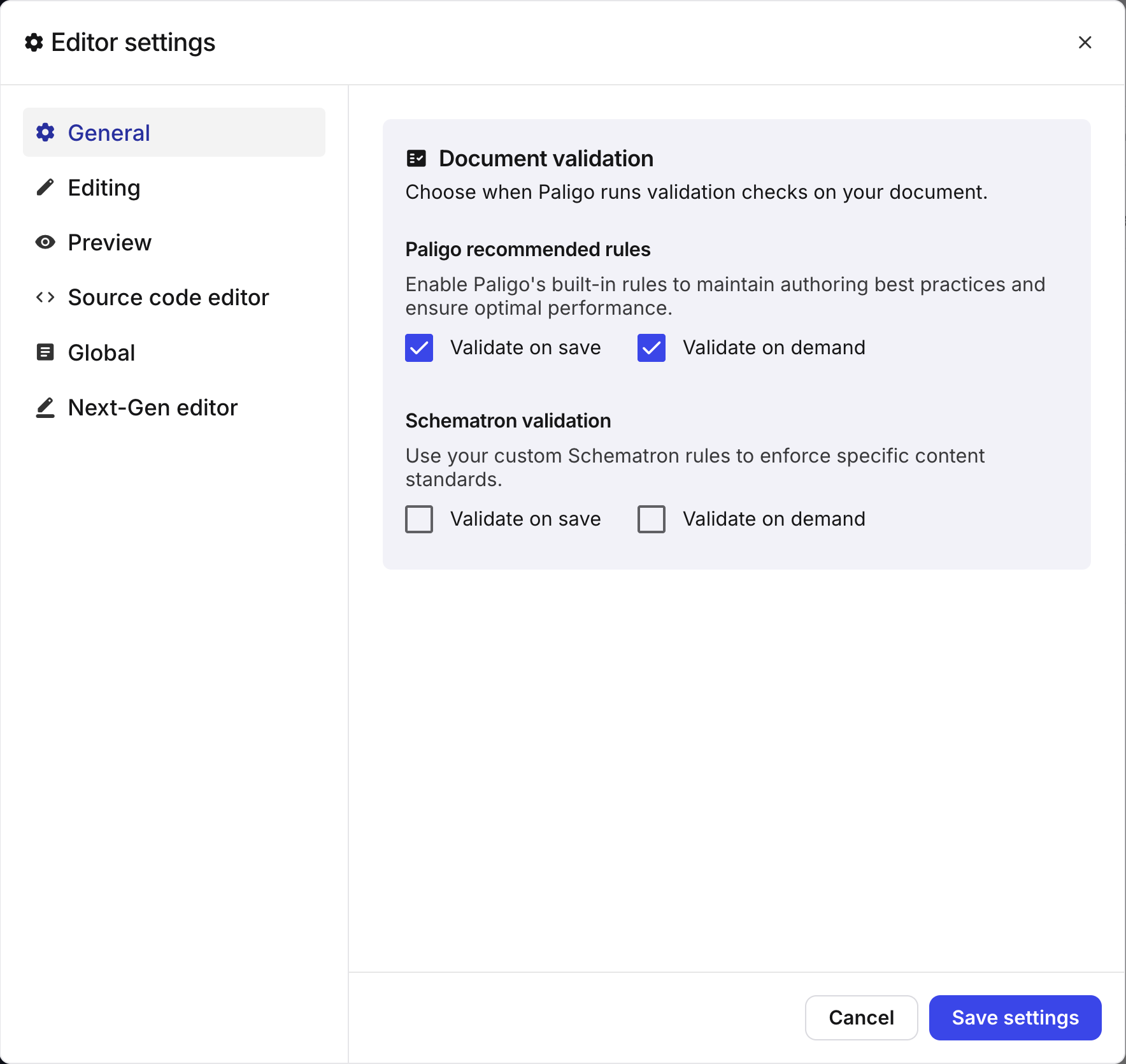
Select the General tab.
Set your validation rules In the Documentation Validation section.
You can choose from two validation schemas:
For each type of validation you can select:
Validate on save: to turn the type of validation on whensaving a topic. Paligo will test that your content complies with the selected rules whenever you try to save a topic. Clear the box to turn the validation off when saving a topic.
Validate on demand: to use that type of validation when youValidate Content Manually. Paligo will test whether your content complies with the selected rules whenever you use the validate option in the Editor's toolbar. Clear the box to turn the validation off.
Select Save settings
Note
Although you can choose to turn off validation, we strongly recommend that you have Paligo XML schema validation enabled as this will prevent you from saving invalid content. Paligo can only publish content that has a valid structure.
Here you can set your autosave and MathType settings.
Select the Editor settings button
.Paligo displays the Editor Settings dialog.
Select the Editing tab.
Turn autosave on or off using the toggle button.
Select the Editor settings button
.Paligo displays the Editor Settings dialog.
Select the Editing tab.
Turn MathType editor on or off using the toggle button.
Select Save settings.
You can generate a preview of the content as PDF, HTML or HTML5 from the Toolbar. For example, you can preview it both as HTML5 and PDF output.
The preview initially uses the default layouts for each type of output and might differ from your customized layout. But you can set Paligo to use your customized layouts instead. This will give you a preview that is closer to how your content will look when you publish it using your own layouts.
To choose the layouts that are used for your previews:
Select the Editor settings button
.Paligo displays the Editor Settings dialog.
Select the Preview tab.
Select all the settings for your preview using the dropdowns for the following preview types:
PDF preview layouts
HTML preview layouts
HTML5 preview layouts
Select Save settings.
By default, the Source Code Editor uses theMonokaitheme, a dark theme easy on the eyes. It has a black background with cerise, green, yellow and white color-coding for the XML elements, attributes and values.
You can set the source code editor to use a different theme. For example, the Chrome theme has a white background with red, blue, cerise and black color-coding.
But you can use any of a number of themes for the look and feel of the Source Code Editor, whatever is more comfortable for you. Just click the cog wheel icon in the toolbar, and select Code Editor.
To change the theme for the source code editor:
Select the Editor settings button
.Paligo displays the Editor Settings dialog.
Select the Source code editor tab.
Select a theme from the dropdown menu in the Theme for the code editor section.
Select Save settings.
Under the Global tab, you can control which elements automatically should get ID attributes assigned to them.
To autogenerate IDs for specific elements:
Select the Editor settings button
.Paligo displays the Editor Settings dialog.
Select the Global tab.
Enter the name of the element you want to autogenerate IDs for in the textfield. Multiple element names should be separated by a space.
Here you can set whether the Next-Gen Editor is used as the default editor.
To enable or disable the Next-Gen Editor as your default editor:
Select the Editor settings button
.Paligo displays the Editor Settings dialog.
Select the Next-Gen Editor tab.
Toggle the Use Next-Gen Editor switch on or off.
Select Save settings.
Note
If you have set the Next-Gen Editoras your default editor, clicking on a publication in the Content managerwill open the publication in topic view, not structure view. In order to view and manipulate the publication's structure, select More options (…) and then Edit > Open structure.
Note
If you choose not to set the Next-Gen Editoras your default editor, you can open topics in the Next-Gen Editorby selecting More options (…), then Edit >Next-Gen Editor