Software and Code Documentation
Code Blocks in Your Content
One of the most common needs when documenting software is to write code blocks. The main element for this is programlisting.
To add a programlisting element:
Position the cursor at the start of the line where you want to add the code block.
Press Alt + Enter ⏎ (Windows) or Command ⌘ + Enter ⏎ (Mac) to display the Element Context Menu.
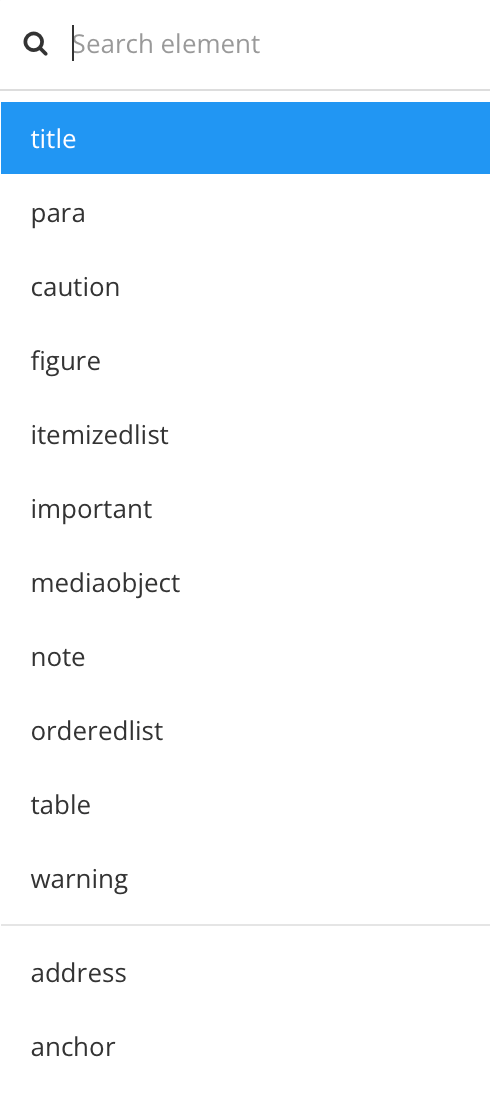
Search for the
programlistingelement and select it.
When you add a
programlistingelement, a code snippet box appears in the topic.
Add your code inside the code snippet box.

The programlisting element is sometimes referred to as "verbatim", as the code you add inside the element will be rendered exactly how it appears in the editor. For example, it will keep spaces and line breaks to represent the code properly. Some other elements also work like this, such as screen and literallayout.
Here, a javascript function has been added inside a programlisting element. This is how the code looks in the output.
function myFunction() { ①var x = "", i;for (i=0; i<5; i++) {x = x + "The number is " + i + "<br>";}document.getElementById("demo").innerHTML = x; ②}
In the sample shown , a code block is added inside the programlisting element. The javascript function contains (1) on the first line and (2) on the last line. These are callouts, which you can use to Annotate Code Blocks.
Annotate Code Blocks
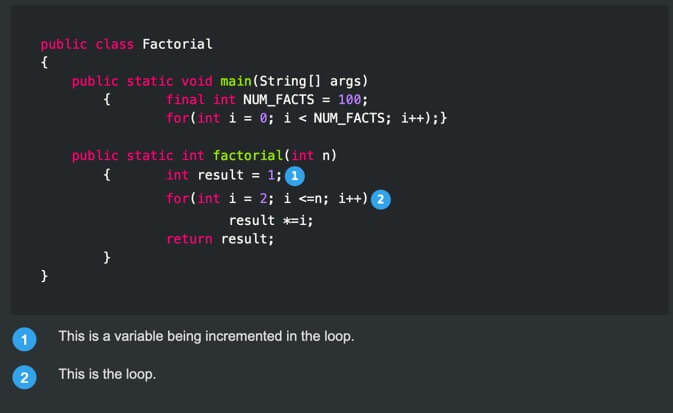
You can annotate code blocks by using the calloutlist element and co elements. In the published output, the callouts act as clickable "hotspots" that highlight parts of the code. When someone selects a "hotspot", they are taken to the callout text explanation for that "hotspot".
For example, in the image below, the code sample has two callout "hotspots" labelled 1 and 2. Below the code sample, there are numbers that match the hotspots, and next to each number is an annotation that explains the purpose of the corresponding code.
To annotate code using calloutlist:
Select a position in the code block where you want a callout "hotspot" to appear.
Press Alt + Enter ⏎ (Windows) or Command ⌘ + Enter ⏎ (Mac) to display the Element Context Menu.
Select the
coelement and give it anxml:id valuein the Element attributes section. Eachcoelement has to have anxml:idvalue that is unique in that specific topic. For example, you could give the firstcoelement thexml:idid_1, the secondcoelement thexml:idid_2 and so on.Add a
calloutlistelement after theprogramlistingelement that contains your code block.TipIt can be a good idea to include the
programlistingandcalloutlistelements inside anexampleelement, so that they are all in a single "container" (theexampleelement).Give each
calloutin thecalloutlistanxml:idas well, different from the ones in thecoelements, e.g "callout_1", "callout_2". Again, these ids need to be unique.Associate the
coelements with thecalloutelements:For each
coelement, add alinkendsattribute. Set the value of thelinkendsattribute to thexml:idvalue of thecalloutthat you want to associate it with.For each
calloutelement, add thearearefsattribute. Set the value of the arearefs attribute to thexml:idvalue of thecothat you want to associate it with.