Global Search and Replace
To update content in topics and publications, you can use the Replace tab in the Advanced Search.
Warning
This is a very powerful feature and you should carefully check all search results before replacing the content.
Tip
Learn more, see Search and Open in Editor and Search and Rename.
Select Quick Search in the top menu.


Select Advanced Search.


Select the Replace tab.
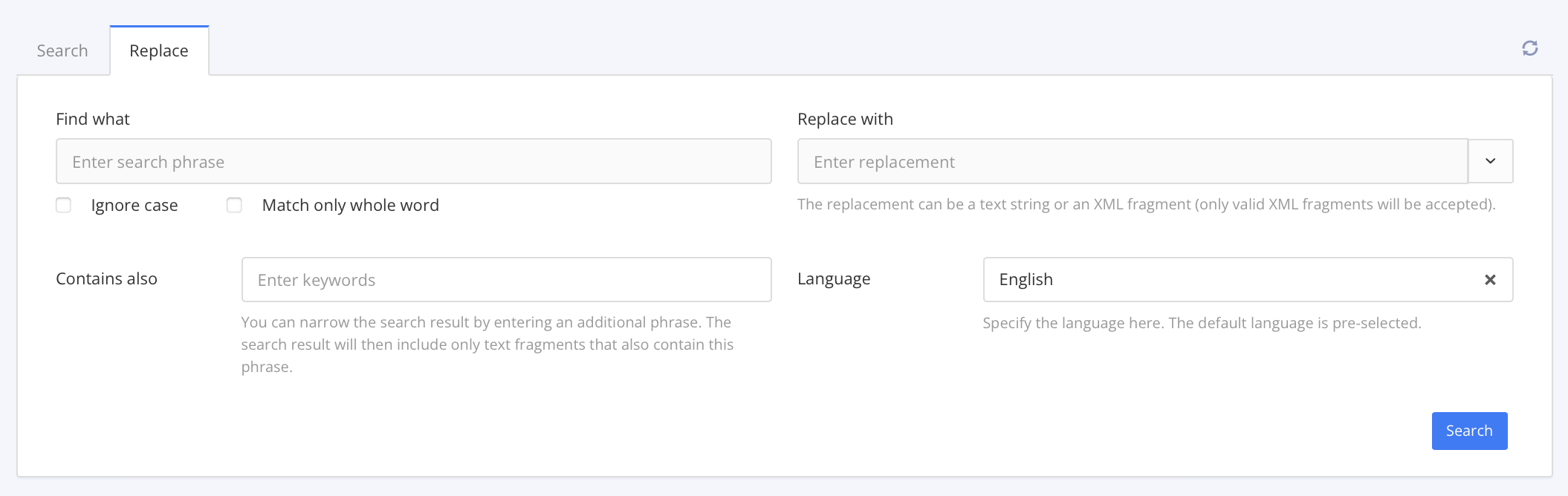
Enter the text string you want to search for in Find what.
In the Replace with field, enter the replacement for the search text string. Either:
Enter the replacement text
Enter an XML inline element
For example, you could replace a search text string of "ACME X3000" in regular text with the same text in bold. For that, you would enter the following XML:
<emphasis role="bold">ACME X3000</emphasis>.Select the arrow icon and then Select variable. Choose the variable set that contains the replacement variable and then select the variable.

Refine your search using the refining parameters. See Refining search parameters for Search and Replace below for more information on how you can refine your search.
Select Search.
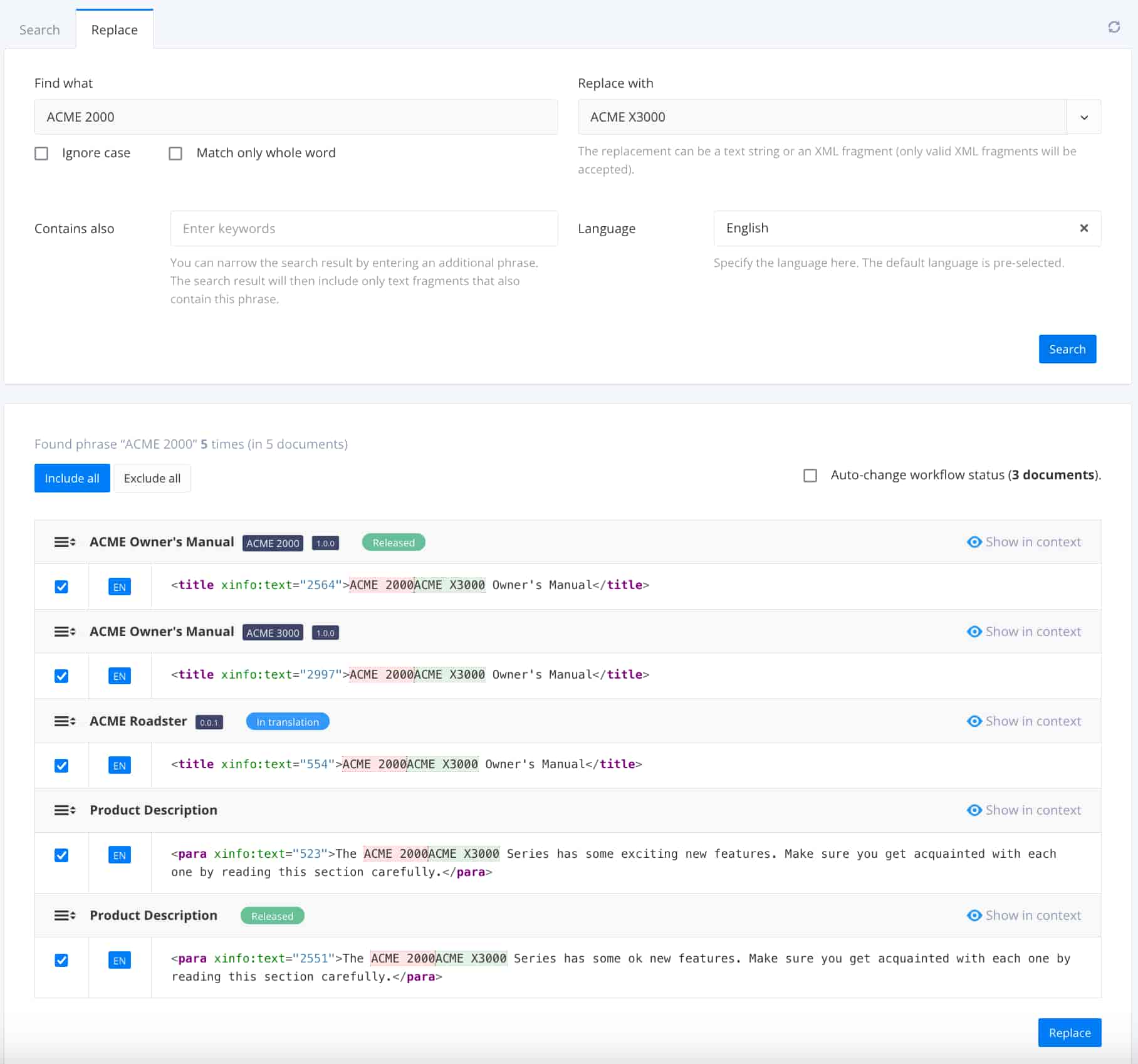
Paligo presents a detailed view of the search results, with the search term marked in red and the replacement text marked in green.
Note
Check the results carefully, to make sure you are not replacing terms you did not intend to.
Use the buttons Include all or Exclude all to check or uncheck all results. Make sure only the ones you want to replace are checked before continuing.
If any topics are:
In a status other than Work in progress, the checkbox Auto-change workflow status appears above the search results. Use this to change the status to Work in progress for those topics.
Checked out, the checkbox Automatic check-in appears above the search results. Use this to check in those topics.
Caution
If you are working in a large team and reusing content across different product owners, you should not check these boxes, but instead leave them and first find out if these can be checked in or have the workflow status changed.
Select Replace.
Paligo replaces the matching content in your topics. You can see the effect of the replacement by looking in any of the topics (that previously contained the search term) in the editor. You will need to re-publish your documentation to see the effects of the replacement in your published outputs.
You can make your searches more granular by using the refinement parameters in the Replace tab. Refining your searches enables you to more accurately target the content you want to replace.
Note
Using the search and replace function only allows for making changes in the actual content. You cannot use it to make changes to other parts of components such as branch labels or filenames.
Note
Wildcards cannot be used in search and replace.
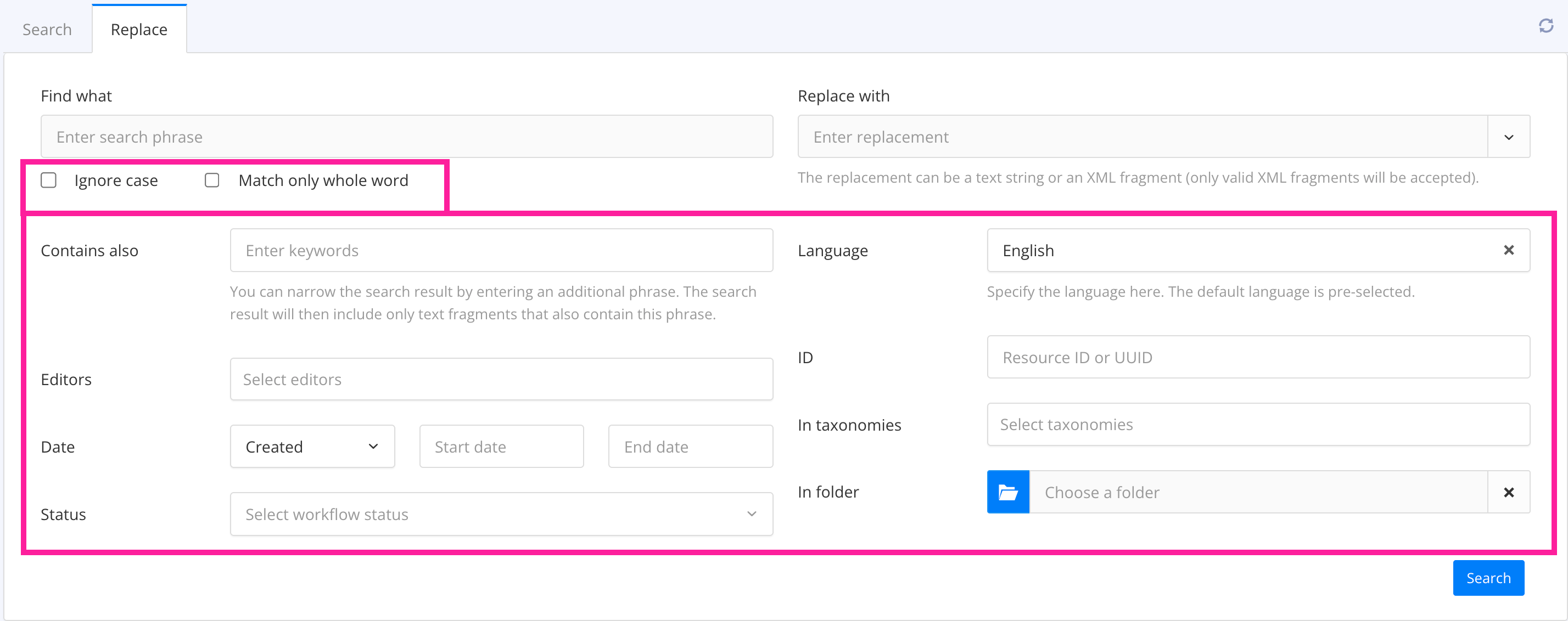 |
You can refine your search withe the following parameters:
Ignore case: to make the search case insensitive.
Match only whole word: to avoid getting matches that are only part of other words.
Contains also: to specify other text fragments included in the phrase to narrow the search to only text fragments that include both phrases.
Editors: to restrict hits to specific editors. You can specify multiple editors in this field.
Date: specify either the component's Creation or Modification date interval.
Status: to restrict search hits to components with a specific status set.
Work in progress
In review
In translation
In translation review
Released
Language to replace text in another language than the source language. Only one language at a time can be searched.
ID: to restrict the search to a specific ID or UUID.
In taxonomies: to only find components that have a specific taxonomy applied. Note that you can only enter one taxonomy in this field.
In folder: to search and replace only in one specif folder in the Content manager.